Why Real Copper Makes a Moscow Mule Taste Better
"Beyond the iconic glint of a hammered finish lies a scientific marvel. Discover why pure copper isn't just a vessel, but a vital ingredient that transforms the Moscow Mule into a sensory masterpiece."

Why Real Copper Makes a Moscow Mule Taste Better: The Science of the Shiver
In the world of fine spirits and artisanal mixology, the vessel is rarely just a container; it is an extension of the cocktail itself. We don’t drink Champagne from a coffee mug, nor do we serve a vintage Bordeaux in a plastic tumbler. But perhaps no drink is as inextricably linked to its vessel as the Moscow Mule. To the uninitiated, the hammered copper mug is a stylish aesthetic choice—a nod to 1940s Hollywood glamour. To the connoisseur, however, pure copper is a functional necessity, a silent partner in the glass that fundamentally alters the chemistry, temperature, and taste of the drink.
At Moscow Mix, we believe that luxury lies in the details that others overlook. When you lift an authentic, heavy-gauge copper mug to your lips, you aren’t just tasting a cocktail; you are engaging in a multi-sensory ritual that has been perfected over eight decades. Let’s explore the visceral science and the lifestyle storytelling behind why real copper makes the Moscow Mule the king of refreshing cocktails.
The Thermal Architecture of the Perfect Chill
The most immediate sensation of a Moscow Mule served in pure copper is the cold. It is not merely the cold of an iced beverage; it is a piercing, structural chill that begins at the fingertips and moves to the lips. This is thanks to copper’s extraordinary thermal conductivity.
From a scientific standpoint, copper is one of the most conductive metals on earth. When you pour a mixture of vodka, spicy ginger beer, and lime juice over crushed ice into a pure copper mug, the metal takes on the temperature of the liquid almost instantaneously. Unlike glass or ceramic, which act as insulators and take time to cool, copper becomes a thermal mirror. This creates a feedback loop: the mug chills the drink, and the drink chills the mug, maintaining a frost-point that keeps your cocktail crisp until the very last sip.
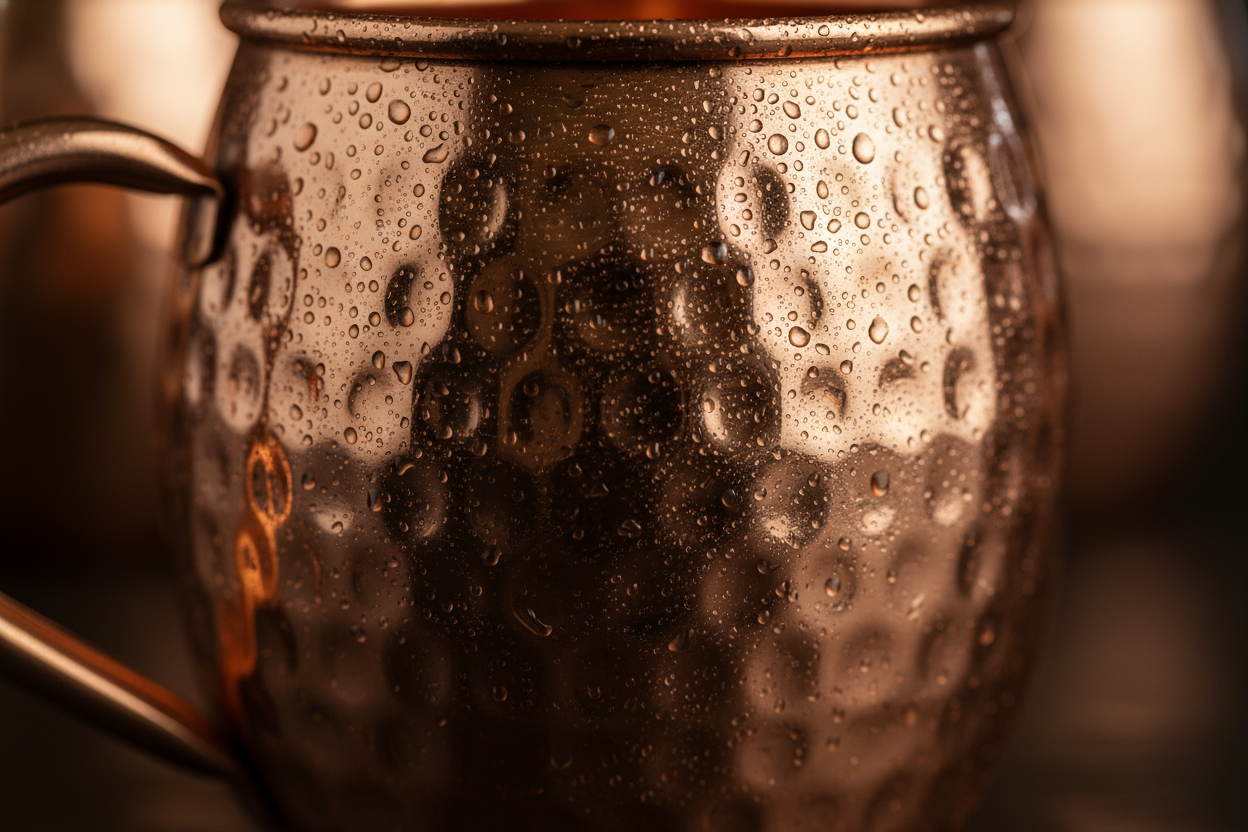
But the benefits go beyond just keeping the liquid cold. The cold rim of a copper mug provides a sensory shock to the lips that creates a psychological perception of heightened refreshment. This "thermal transition" prepares the palate, making the effervescence of the ginger beer feel sharper and the citrus notes of the lime feel more vibrant. In a glass, the drink warms as your hand transfers heat through the walls. In a pure copper mug, the handle and the body work together to dissipate your body heat, ensuring the integrity of the cocktail remains uncompromised.
The Alchemical Interaction: Ginger, Lime, and Metal
Beyond temperature, there is a subtle chemical dance occurring inside the mug. For decades, mixologists have debated the "copper taste." While high-quality mugs are often lined with a thin layer of nickel or food-safe lacquer to prevent over-leaching, the presence of copper at the rim and the overall construction of the vessel play a role in how we perceive acidity.
When the citric acid of the lime juice meets the cold surface of the copper, it begins to oxidize slightly, which many enthusiasts claim softens the harsher, "pithy" notes of the citrus while accentuating its bright, floral top notes. This interaction serves to bridge the gap between the sharpness of the lime and the spicy heat of the ginger.
Speaking of ginger, the carbonation in ginger beer reacts uniquely within a copper environment. The microscopic textures of a hammered copper surface provide thousands of tiny nucleation points. This doesn't just look beautiful as the condensation forms on the exterior; it influences the way the bubbles release their aroma. A Moscow Mule in a copper mug often feels more effervescent, with a "bite" that lingers on the back of the throat—a hallmark of a perfectly balanced Mule.
An Olfactory Awakening
We taste with our noses as much as our tongues. The architecture of a traditional Moscow Mule mug—slightly bulbous with a tapered rim—is designed to concentrate the aromas of the ingredients. Because the metal is so cold, it forces the volatile oils in the mint garnish and the lime zest to stay dense and concentrated near the surface of the drink.
As you tilt the mug to drink, your nose is positioned directly over this chilled micro-climate. You aren’t just smelling ginger; you are experiencing a pressurized bouquet of botanical aromatics. The contrast between the warm air of a summer evening and the frigid, scented air inside the mug creates a vapor effect that defines the luxury drinking experience. This is why a Moscow Mule served in a glass often feels "flat" by comparison; without the thermal wall of the copper, the aromatics dissipate too quickly into the room.

The Pitfalls of the 'Copper-Plated' Illusion
In a market flooded with mass-produced barware, it is easy to be seduced by the low price point of copper-plated stainless steel. However, for the true enthusiast, these are pale imitations. Plated mugs lack the thermal mass of pure copper. Because stainless steel is a poor conductor, you lose that instant "shiver" on the lips. The mug stays room temperature while the drink inside struggles to stay cold.
Furthermore, there is the question of weight and soul. A pure copper mug has a heft to it—a gravitational authority that feels significant in the hand. It rings with a distinct, melodic 'tink' when an ice cube hits the side, a sound quite different from the dull thud of plated steel. Luxury is about the honesty of materials. Just as a gold watch carries a different energy than one that is merely gilded, a pure copper vessel carries the legacy of the craftsmen who hammered it into shape.
The Ritual of the Patina
Finally, we must talk about the passage of time. One of the joys of owning authentic copper barware is the patina. Over years of use, pure copper develops a character entirely its own. It tells the story of the parties it has hosted and the quiet evenings it has punctuated. While some prefer to keep their copper polished to a high mirror shine, others embrace the deep, antique glow that only comes with age.
This evolving aesthetic is something a plated mug can never achieve. When plating wears off, it reveals a dull grey underlayer—a sign of decay rather than age. Pure copper, however, only grows more beautiful, becoming a topographical map of your journey as a host and a connoisseur.
Conclusion: Choosing Your Vessel
The Moscow Mule is a simple cocktail—vodka, ginger, lime. But because it is simple, there is nowhere for low-quality ingredients or poor craftsmanship to hide. By choosing a pure copper mug, you are making a commitment to the science of flavor and the art of the experience. You are ensuring that every sip is as cold as the first, every aroma is captured, and every moment is elevated.
The next time you prepare a Mule, skip the glass. Reach for the copper. Feel the frost bloom across the hammered surface, smell the intensified mint, and taste the sharpened bite of the ginger. You’ll realize that the mug isn't just a choice—it’s the soul of the drink.